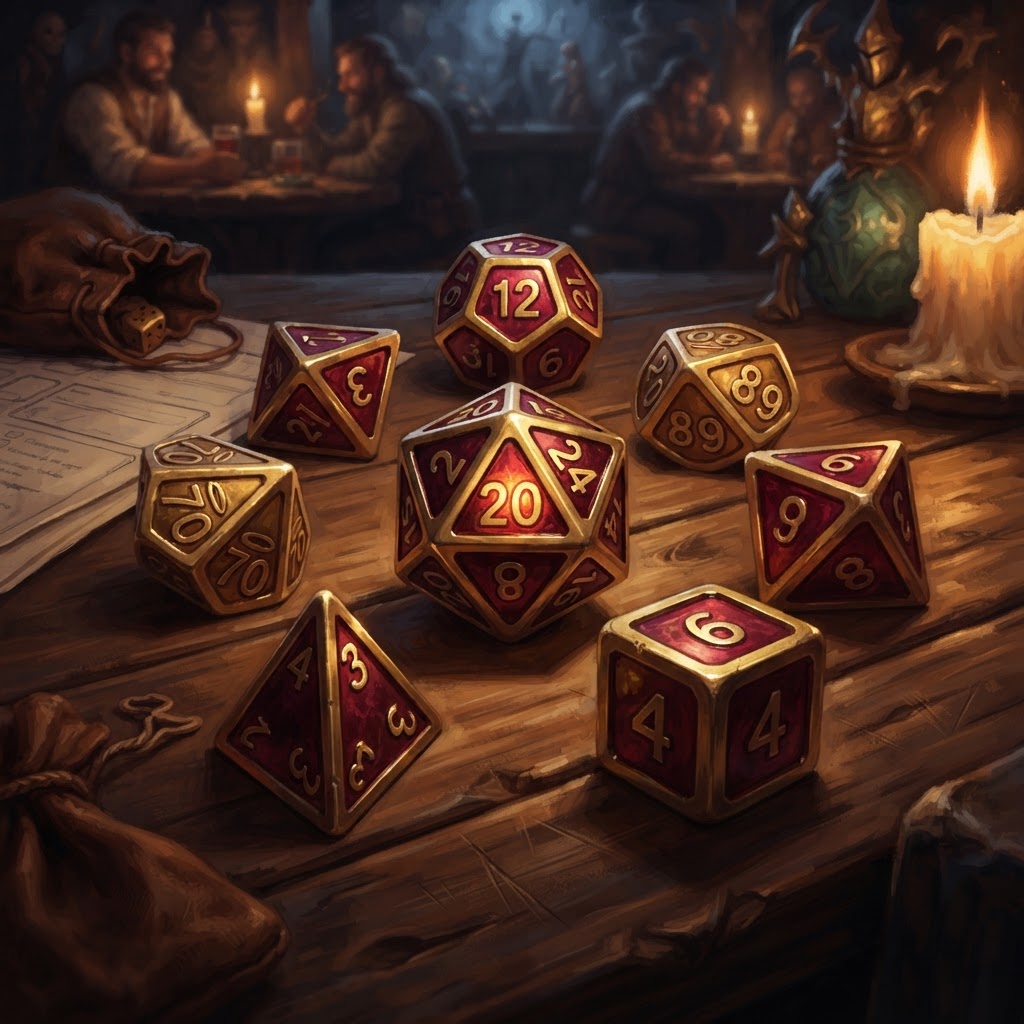
The Seven Dice of D&D
A D&D dice set contains seven polyhedral dice, each with a different number of sides. They are named by their face count, so a twenty-sided die is a d20. Here is the full set:
- d4 — the four-sided pyramid, used for small weapons like daggers
- d6 — the classic cube, used for many weapons and spells
- d8 — used for medium weapons like longswords
- d10 — used for medium-heavy weapons and percentile rolls
- d12 — used for heavy weapons like greataxes
- d20 — the heart of the game, used for nearly every check and attack
- d100 (two d10s) — used for random tables and wild magic surges
The d20: Heart of the Game
When your character attempts something with an uncertain outcome — swinging a sword, persuading a guard, picking a lock — you roll a d20. You add a modifier based on your ability score and your proficiency, and compare the total to a target number set by the Dungeon Master. Meet or beat it, and you succeed.
A natural 20 (the highest possible roll before modifiers) is usually a triumph, and a natural 1 is usually a fumble. These moments are the ones players remember for years. The d20 is not just a die; it is the arbiter of fate at the table.
Damage Dice
When your attack hits, you roll damage. The die depends on the weapon or spell. A dagger rolls a d4, a longsword rolls a d8, a fireball rolls 8d6. You add your Strength or Dexterity modifier to weapon damage, but not to spell damage unless a feature says otherwise.
More dice means more consistent averages. A greatsword (2d6) will rarely roll very low or very high, while a greataxe (1d12) swings more wildly. Neither is wrong — pick the one that feels right for your hero.
Percentile Dice (d100)
Two ten-sided dice can be rolled together to generate a number from 1 to 100. One die represents tens, the other ones. This 'percentile roll' is used for random encounter tables, wild magic effects, and the occasional bizarre magical outcome.
Some sets include a dedicated d100 — a large, nearly spherical die that rolls forever. Most players just use two d10s of different colours and agree which is tens before rolling.
Reading the Dice
On a d4, the number that sits upright at the top point of the pyramid is your result. On every other die in the set, the result is the face that lands flat on the bottom — you read the number resting on the table, not the one pointing up.
If your rolls feel cursed, you are in good company. Every player has a dice superstition. The truth is that probability is merciless and fair in equal measure, and over a long campaign the numbers even out. Until they do, keep a spare set handy.
There is no such thing as a lucky die. But never tell a player that while they are rolling.