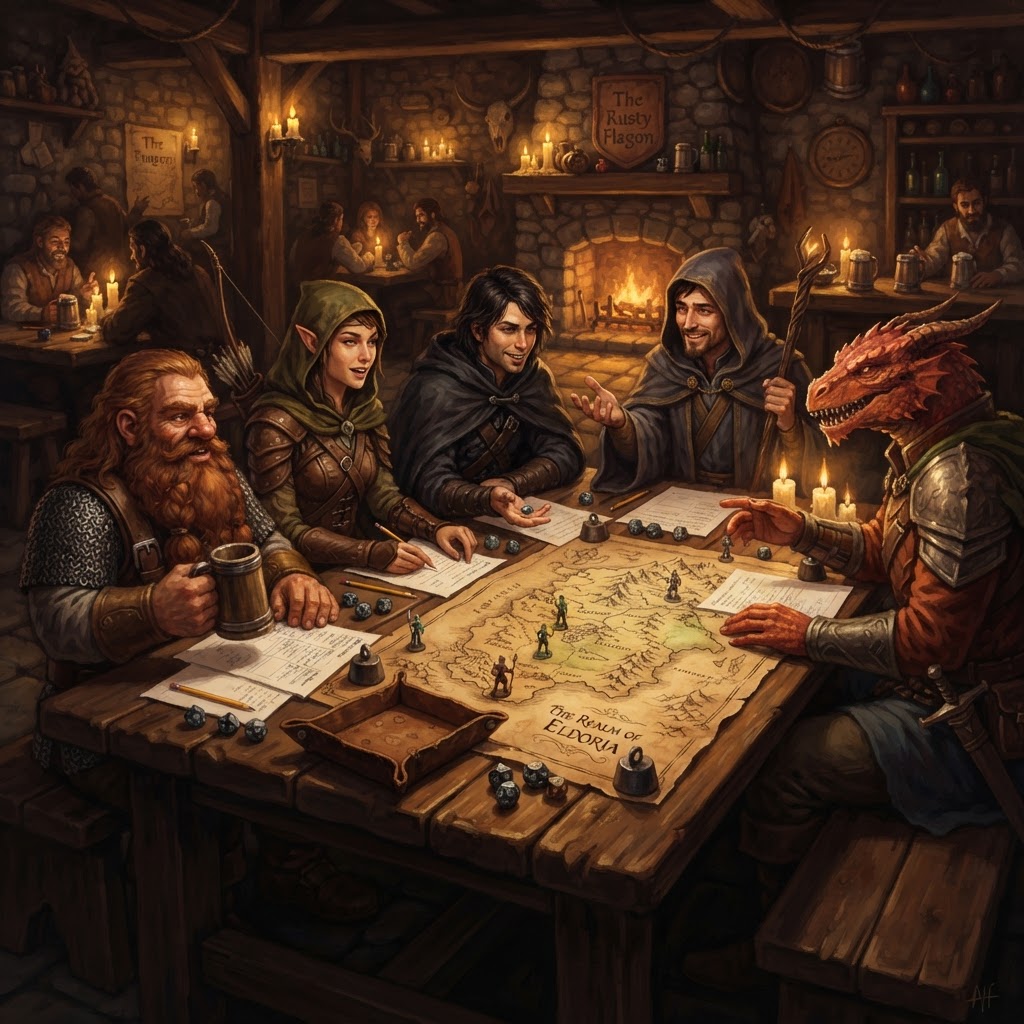
What Is Dungeons & Dragons?
Dungeons & Dragons is a tabletop roleplaying game where a group of friends gather around a table (or a virtual one) to tell a shared story. One person takes on the role of the Dungeon Master, describing the world and the challenges within it, while everyone else plays a single character navigating that world.
Unlike a board game, there is no fixed path. You can attack the dragon, negotiate with it, sneak past it, or try to befriend it. The rules exist to resolve uncertainty — will your sword swing connect? Will your charm persuade the guard? — but the story is yours to shape. That freedom is what has kept players coming back for fifty years.
What You Need to Play
Getting started is simpler than it looks. You do not need a mountain of books on day one. Here is the essential kit for your first game:
- A set of polyhedral dice (seven dice, from the d4 to the d20)
- A character sheet — printed or digital, provided free by the game
- The basic rules, available as a free download from the official D&D site
- A group of three to six players plus a Dungeon Master
- Pencils, an eraser, and a willingness to try
The Dungeon Master
The Dungeon Master, or DM, is the referee, narrator and world-builder rolled into one. The DM describes what the characters see, voices the monsters and the shopkeepers, and decides what happens when the rules do not cover a situation. It sounds like a lot of responsibility, and it is, but it is also the most creative seat at the table.
If you are the DM, remember that you are not the enemy. Your job is to present believable challenges and let the players find their way through them. A good DM wants the players to succeed — but only after they have earned it.
Your First Session
Your first session will likely be a little chaotic, and that is perfectly normal. Nobody remembers every rule, not even veterans. When you are not sure how something works, make a reasonable ruling in the moment and look it up later. Momentum matters more than precision in a first game.
Expect to spend part of the session making characters if you have not done so already. Expect a few tangent conversations and a moment where someone tries something the rulebook never imagined. These are not interruptions — they are the game.
The goal of your first session is not to finish an adventure. It is to end the night thinking, 'I want to do that again.'
Tips for New Players
First, do not worry about optimising your character. A suboptimal character with a memorable personality is infinitely more fun than a perfectly built one with no soul. Second, take notes. You will be glad you did three sessions in. Third, share the spotlight — when another player is roleplaying, you are an audience member, and that is a good thing.
Most importantly, remember that D&D is a cooperative game. You win when the whole table has a great story to tell. Play your character boldly, support your fellow adventurers, and let the dice fall where they may.