The Classic Dungeon Crawl
The dungeon crawl is the foundation of D&D, and it remains one of the most satisfying frameworks to run. A party descends into a mapped environment — a ruined fortress, a forgotten tomb, a goblin warren — and navigates its rooms, traps, and monsters toward a goal at the bottom.
To make it your own, give the dungeon a reason to exist. Who built it, why did they abandon it, and what has moved in since? A dungeon with a history is a dungeon the players remember. A dungeon that is merely a sequence of rooms with monsters in them is one they forget by the next session.
Political Intrigue
If your group enjoys negotiation and social play more than combat, a political campaign places the party in a web of factions, secrets, and rivalries. The city is the dungeon, and a well-placed rumour is as powerful as a fireball.
Start small: two factions competing over a single prize — a trade route, an inheritance, a seat on the council. Let the players choose a side, and let their choice have consequences. As the campaign grows, the stakes grow with it, until the party's decisions shape the fate of a kingdom.
Intrigue lives or dies on what the players know. If they do not understand the factions, they cannot play the game. Feed them information through NPCs, found documents, and overheard conversations.
The Open Sandbox
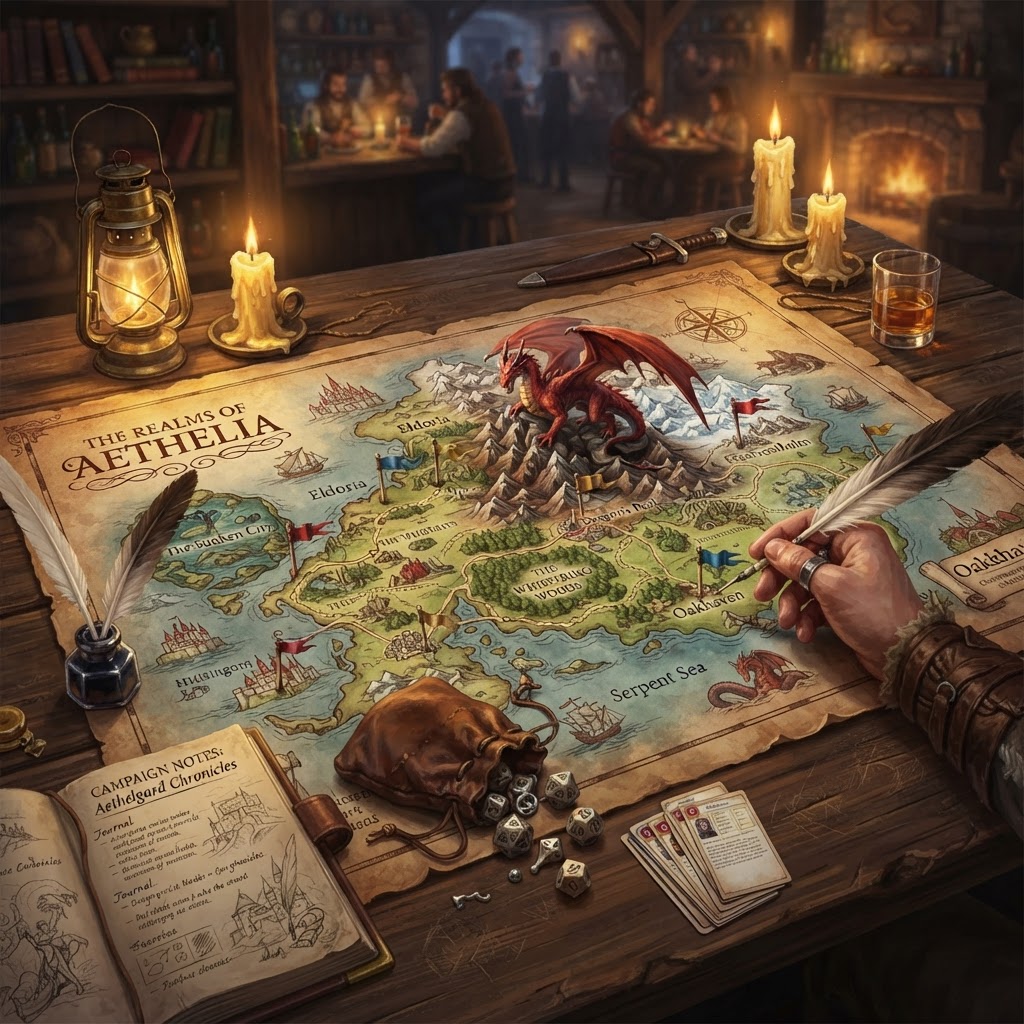
A sandbox gives the players a region to explore and lets them choose where to go and what to engage with. You prepare a map seeded with hooks — a bandit camp, a wizard's tower, a haunted forest — and the players pick their path.
This is the most demanding style to prepare but the most rewarding to run, because the players are genuinely in control. The key is not to prepare everything, but to prepare enough that wherever they go, there is something interesting waiting. A toolkit of reusable NPCs and flexible encounters is your best friend.
Mystery and Investigation
An investigation campaign frames each session as a puzzle. A crime has been committed, a person has vanished, a curse has taken hold, and the party must gather clues, interview witnesses, and piece together the truth before time runs out.
Design mysteries backwards. Decide what happened, then decide what clues it left behind, then decide where those clues can be found. This ensures the mystery is solvable — there is nothing more frustrating for players than a puzzle the DM has not actually worked out.
One-Shot Ideas
Not every campaign needs to last a year. A one-shot is a self-contained adventure designed to be completed in a single session, and it is the perfect way to try a new idea, introduce new players, or run something between campaigns.
Good one-shots have a tight scope: a single location, a clear objective, and a ticking clock. A heist that must happen tonight, a festival under threat, a rescue before dawn. The constraint is what makes a one-shot sing — there is no next session to defer to, so everything must resolve now.